Cleaning HVAC ducts and extractor hoods

Cleaning HVAC ducts and extractor hoods
Comprehensive HVAC maintenance services for your commercial facilities
A clogged ventilation system is never just a cosmetic issue. It contributes to poor indoor air quality, leads to excessive energy consumption, and—in the case of commercial range hoods—poses a documented fire hazard. XLG has been servicing technical systems at industrial and commercial sites in Belgium, France, and Luxembourg for 40 years, and applies the same meticulous workshop standards to the maintenance of ventilation systems.
The service combines two complementary areas of expertise that our teams handle using separate protocols, since the contaminants and associated risks are not of the same nature:
- Ventilation duct cleaning: dust, fine particles, and industrial process residues in industrial, commercial, and hospital facilities, as well as cleanrooms.
- Cleaning range hoods: Grease buildup in commercial kitchens, with fire safety as a top priority.
A facility manager or technical director who manages a site with both types of systems thus has a single point of contact who is already familiar with the building and its ventilation system.
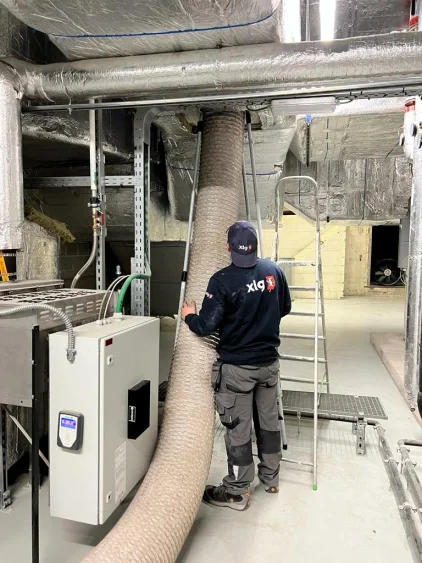
Ventilation systems and commercial kitchens: two areas of expertise, one high standard
In a conventional ventilation system—consisting of rigid or flexible ducts, an air-handling unit, and supply and return air grilles—the key challenge is maintaining indoor air quality (IAQ) and complying with the cleanliness thresholds established by the European standard EN 15780. In a kitchen range hood, the primary concern is fire safety: grease buildup in the exhaust plenum, baffle filters, and the vertical duct serves as a fuel source that, when combined with the heat generated by cooking appliances, can cause a duct fire that spreads rapidly throughout the entire exhaust system.
Why Air Duct Maintenance Is a Regulatory and Health Requirement
In Belgium, employers are required to ensure good indoor air quality in the workplace, particularly through the maintenance of ventilation, air-handling, and heating systems—a requirement that has been incorporated into the Code on Well-Being at Work since the Royal Decree of May 2, 2019. This obligation is accompanied by a technical standard: European Standard EN 15780, which defines the criteria for assessing the cleanliness of ventilation systems and the cleaning procedures to be followed.
EN 15780: The Technical Standard for Air Cleanliness
The EN 15780 standard classifies ventilation systems according to their level of sensitivity—an operating room or a cleanroom does not have the same cleanliness requirements as an office space—and sets, for each class, a maximum dust deposition threshold beyond which cleaning becomes mandatory. It is linked to the EN 12097 standard, which requires the presence of access panels sized and positioned to allow for inspection and cleaning of the ductwork without complete disassembly.
A Challenge for Indoor Air Quality and Fire Safety
A clogged duct system forces the fans to work against increased pressure drop, which raises electricity consumption and reduces the actual flow of fresh air delivered to occupants. From a health perspective, the accumulation of dust, mold, and volatile organic compounds in the ducts degrades indoor air quality and can exacerbate respiratory and allergic conditions. With a range hood, the problem is more immediate: a hot spot in a duct clogged with grease can trigger a duct fire in a matter of minutes.
Why Choose XLG for This Service?
40 years of hands-on expertise serving the manufacturing and service sectors
XLG is a Walloon-based group that has been active for 40 years in industrial maintenance and facility management, working alongside industrial and service sector companies such as Safran, Alstom, Aperam, Holcim, and BNP Paribas. This culture of operating in demanding environments—compliance with safety protocols, coordination with on-site maintenance teams, and access management in sensitive areas—is reflected in the way our teams approach air duct cleaning: it is never a standalone service, but rather a process fully integrated with the site’s operational constraints.
One team for all your ventilation ducts and range hoods
Because a single building often combines a general ventilation system with a professional kitchen (corporate cafeteria, institutional dining, or hospitality facilities integrated into an industrial site), XLG offers comprehensive management of both areas, with a single maintenance schedule and a dedicated point of contact. Learn more about each service: ventilation duct cleaning and range hood cleaning.
Coverage in Belgium, France, and Luxembourg
Our technical teams operate throughout Belgium, northern France, and Luxembourg, applying the same rigorous standards in their work.

Maintaining good air quality
Regular cleaning of ventilation ducts is essential to maintain good indoor air quality. Accumulated contaminants can compromise respiratory health.
Improving energy performance
Cleaning ventilation ducts improves energy performance by ensuring optimum air circulation, thus reducing the load on the heating and air-conditioning system.
Reduce pollen and dust allergies
By cleaning ventilation ducts, you can reduce pollen and dust allergies by eliminating potential sources of allergens that are spread throughout your home via the ventilation system.


Our methodology for duct cleaning
Our air duct cleaning technique loosens dirt, extracts it by suction and collects it in filter bags.
- Step 1: Check the ventilation network plan
- Step 2: Camera inspection of ducts
- Step 3: Current status report
- Step 4: Cleaning the ducts
- Step 5: Cleaning inspection by camera
- Step 6: Finalizing the service report

Serving our customers, our daily pride
Contact our experts
Your projects deserve our expertise
Tell us about your project and let's see how we can bring it to life.


Our other specialized sites
Because we believe that differences enrich us and that team spirit makes us stronger.

